
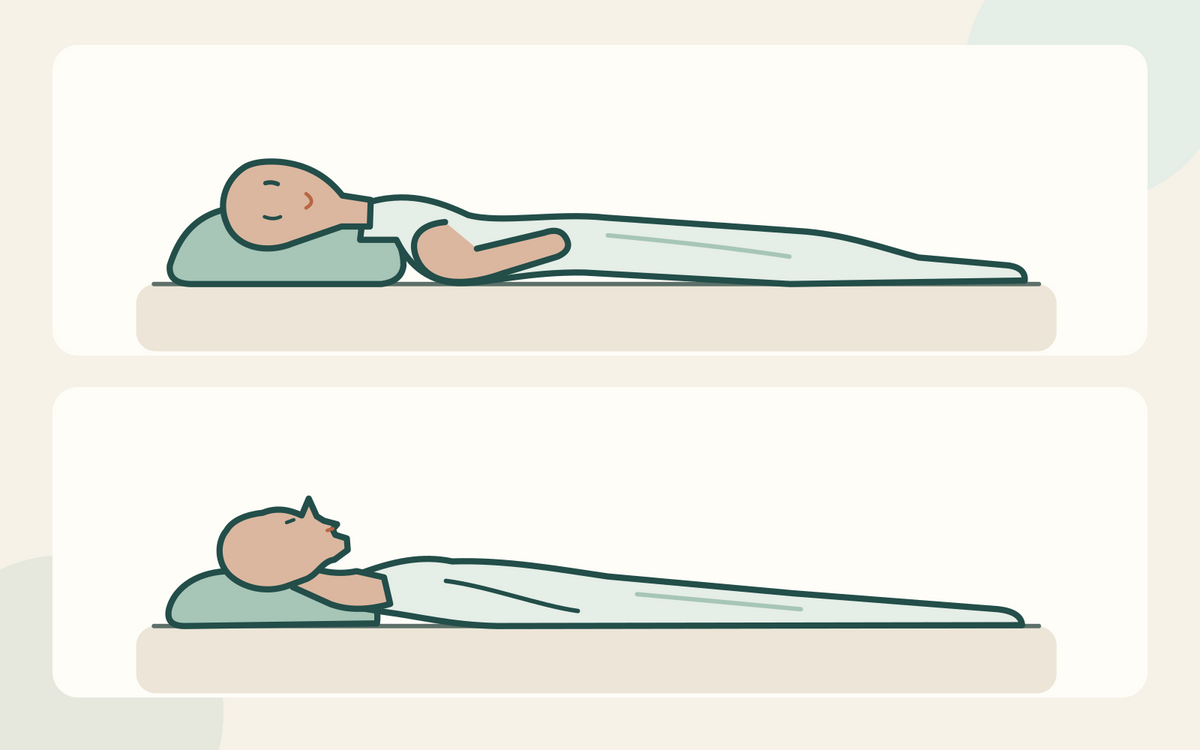
Start with the relationship between your head and body on your own bed when you are looking for a comfortable pillow height. The gap created by your shoulder when you lie on your side differs from the curve your neck needs supported when you lie on your back. A pillow that looks full on a shelf, or feels comfortable to someone else, may feel different to you.
Height and softness are easy to confuse. A pillow that feels soft under your hand may still hold your head higher than you like. Another that looks thin may feel uncomfortable for a different reason. Rather than starting with a single measurement, notice whether your usual setup pushes your head in an unwanted direction and whether you can change position comfortably. Then compare a small, reversible change.
Decide which feeling you want to change
Before replacing your pillow, ask a few practical questions. Do you mostly sleep on your side, on your back, or turn between them? Once your head is settled, can you stay comfortable, or do you keep folding and rearranging the edge? Is height the problem, is it the surface feel, or is the whole bed uncomfortable? These questions help identify what to compare before choosing a product.
For example, your head might feel pushed forward when you lie on your back, while the same pillow feels comfortable on your side. Keep both observations. Remembering only the first position could leave out another you use during the night. A short note is enough. Describe the position and the feeling before focusing on the name of the pillow or its filling.
Try the pillow on the bed you normally use
Use your usual mattress, bedding and pillowcase for the comparison. Squeezing a pillow in a shop, or sitting against it on a sofa, cannot answer every question about lying on your own bed. Settle into your normal position and notice how the pillow sits under your head, rather than judging only its thickness when empty. Check whether a bunched pillowcase is adding an uncomfortable distraction.
Changing everything at once makes preferences harder to separate. If you try a different bed, a new cover and another pillow together, it becomes difficult to say which change you liked. Use your existing setup as a starting point, then change the part you want to compare. This is a way to organize preferences. You do not need to hold yourself rigidly in a particular pose.
Consider the shoulder gap when lying on your side
When you lie on your side, your shoulder creates a gap between your head and the mattress. The physiotherapist's guide from Ohio State Wexner Medical Center explains the importance of enough height to support the relationship between the neck and trunk. Notice whether your head seems to fall toward the bed or be pushed upward. You are looking for unwanted tilting, rather than measuring an exact angle.
If you keep folding the pillow to find a comfortable spot, record that too. Liking the folded feel does not mean you must keep it folded all night. It helps describe what you want when comparing a different height, shape or filling. Raising your shoulder, holding your chin on an imaginary line or forcing yourself to copy a photograph will not make the comparison more useful.

Notice whether your head feels pushed forward on your back
Supporting the natural curve of your neck is different from adding height beneath your head. Ohio State's guidance considers both avoiding a pillow that pushes the head forward and avoiding a position where the head has to reach for support. If your chin feels crowded downward when you settle normally, include that observation. A label describing a pillow as suitable for back sleeping does not replace your own comfort.
Check how a height you like on your side feels when you turn onto your back. Comparing both positions can help describe the difference. Do not press your neck down or pull your head backward to make a position work. If you cannot settle comfortably, you do not have to continue. Changing position and returning to the previous setup are both possible outcomes.
Include the positions you turn into during the night
If you use more than one sleeping position, include that in your comparison. Lie on your back, then turn onto your usual side. Is it easy to resettle your head, or do you need to rearrange most of the pillow each time? A feeling you like in one position may change in another. That is a useful observation, not a detail to ignore.
You do not need to make yourself face the same way all night to assess a pillow. Think about your everyday habits instead. If you sleep on your front, do not expect a new pillow alone to change that habit immediately. If a healthcare professional has recommended a particular position for you, keep that advice in place. Avoid holding an uncomfortable pose simply to make a pillow work.
Separate the head pillow from body support
A pillow beneath your head has a different role from support placed between your knees or beside your body. South West Yorkshire NHS posture guidance gives examples of resting with support between the knees when side lying or beneath them when on the back. These supports sit elsewhere. Finding a body pillow comfortable does not establish that the height beneath your head and neck suits you.
For example, you may like a separate support between your knees but find your head pillow too high. Assess the head support on its own instead of treating both as one change. Raising the body support to compensate can make it harder to tell which part is doing what. For questions about positioning during pregnancy, see the separate guide to side sleeping and pillow support.
Make a small change only if the filling is adjustable
If a pillow is designed for adjustable filling and its manufacturer permits it, adding or removing filling can let you compare heights. Ohio State describes this as one way to find personal comfort. First confirm that the product is meant to open for that purpose. Cutting into a sealed pillow, opening its seams or changing an internal structure that is not adjustable is not part of this comparison.
With an adjustable design, keep track of the starting arrangement. Try a small change rather than a large one, then return to your usual lying position. Store removed filling according to the product's instructions so that you can restore the earlier setup. There is no need to search for a universal weight of filling. You are comparing how your particular pillow feels on your usual bed.

Describe height, softness and shape separately
You may like the surface feel and height of the same pillow, but describing them separately can make the choice clearer. Perhaps the surface feels pleasant while the position of your head does not. Another pillow might have a comfortable height but an awkward shape. Instead of summarizing everything as firm or soft, write one sentence about what you like and another about what you want to change.
Imagine adjusting only the filling one evening. The next morning, you also remember that the room was unusually hot. Note these as separate details rather than treating one morning as a definite verdict on the whole night. You do not have to record or measure everything. The aim is simply to remember the pillow observation without mixing it up with other experiences from that night.
Make the description as concrete as a shopping note. Saying that you like the surface but want your head a little lower when lying on your back is more useful than saying that the pillow did not work. It narrows what to look for next. Identifying the part you dislike means you need not change every feature you already enjoy.
Separate reading support from your sleeping setup
The arrangement you use for reading or watching something in bed may differ from the one you want for sleep. Ohio State discusses sitting with back support rather than reading for a long time while lying on your back. The cushions behind you while reading therefore do not establish the height you need beneath your head when sleeping. Decide which pillow will remain when you lie down.
For example, you might sit against two supports and gradually lean forward over a book. When you finish, put the book and other items aside and settle into your normal sleeping position before judging the height. That separates a support used behind your back from one used beneath your head. A product described as multipurpose does not mean every arrangement will feel equally comfortable to you.
Look at the pillow's condition before relying on its age
Do not base a decision to reassess a pillow only on its purchase date. Ohio State's guide says there is no definitive replacement interval and suggests reconsidering a pillow when it no longer provides usable support. If you cannot recreate a previously comfortable arrangement, find yourself repeatedly adjusting the pillow, or notice a change in its condition, those are more concrete starting points than a calendar rule.
Follow your own product's care label and manufacturer instructions. A process suitable for one filling may be unsuitable for another. Avoid trying an unlisted washing or drying method simply to change the feel. If you consider buying a replacement, read its dimensions, adjustment options, care requirements and any trial or return terms separately before purchasing.
Get advice when symptoms persist
Do not continue with discomfort that starts or worsens during a comparison because you think you need to get used to it. Seek professional advice if neck pain does not ease after a few days, or if you have pain, numbness, tingling or weakness in an arm. Severe pain or dizziness should also prompt advice rather than being explained away as pillow height. The NHS-hosted neck pain booklet identifies these symptoms for assessment.
Your comparison may leave you with a simple observation. The existing pillow feels comfortable in one position but not another, or a small adjustment has not created the feeling you wanted. Keep that information without forcing another change. Considering head position, freedom to resettle and the product's actual adjustment options gives you more to work with than a single word on its label.
Sources
- Ohio State Wexner Medical Center guide to choosing a pillow. Sean Wilging, physical therapist, November 22, 2024. Guidance on sleeping position, pillow height and adjustable filling.
- South West Yorkshire NHS posture guidance. Advice on head and neck positioning and the different uses of body support.
- Neck pain booklet hosted by Calderdale and Huddersfield NHS. Arthritis Research UK guidance, using the sections on sleep positioning and symptoms that warrant professional advice.
